Research Results! Read ’em Here!

The White House Office of Science and Technology Policy (OSTP) on February 22, 2013, published a memorandum on public access to research results that for many folks has been too long coming. After much discussion, significant public outcry from scientists and publishers in the US and around the world, and a petition on the White House’s We the People website, John Holdren, OSTP Director, announced that Federal agencies with more than $100 million in R&D expenditures must develop plans to make published results of federally funded research freely available to the publish within one year of publication. The OSTP memorandum encourages agencies to work together rather than developing separate approaches and systems where appropriate. Agencies have six months to submit a draft implementation plan to the Office of Management and Budget (OMB).

The memorandum also requires that agencies ensure that metadata about each relevant publication be available coincident with initial publication and that included in that metadata where possible, is a link to the location where the publication and associated supplemental materials will be available after the embargo period (up to 12 months). Agencies are directed to use a “data format that ensures interoperability with current and future search technology.”

In maximizing public access to published results of federally funded research, agencies are instructed to “Allow the inclusion of appropriate costs for data management and access in proposals for Federal funding for scientific research” and to “provide for the assessment of long-term needs for the preservation of scientific data in fields that the agency supports”.

Continuing Resolution and Sequestration – Oh My!

In a notice posted February 1st, NOT-OD-13-043, NIH noted that should sequestration take effect, they “likely will reduce the final FY 2013 funding levels of non-competing continuation grants” and went on to say that fewer competing awards will likely be made in order to meet the necessary budget limitations. Each Institute or Center will announce their specific approach to meeting the new budget levels in the event of a sequestration.

The effects of sequestration, should it come to pass, are layered on top of the existing Continuing Resolution (CR) under which NIH is currently operating. Under the current CR, continuation awards are generally being funded at levels up to 90% of the previously committed level. These levels may be further reduced in the event of sequestration.

In her letter to the Senate appropriations committee, Kathleen Sebelius, said:

Cuts to the National Institutes of Health (NIH) due to sequestration would delay progress on the prevention of debilitating chronic conditions that are also costly to society and on the development of more effective treatments for common and rare diseases affecting millions of Americans. In general, NIH grant funding within states, including Maryland, will likely be reduced due to both reductions to existing grants and fewer new grants. We expect that some existing research projects could be difficult to pursue at reduced levels and some new research could be postponed as NIH would make hundreds fewer awards. Actual funding reductions will depend on the final mix of projects chosen to be supported by each Institute and Center within available resources. With each research award supporting up to seven research positions, several thousand research positions across the nation could be eliminated.

These impacts on NIH are only a subset of the impacts on the Department of Health and Human Services and represent only a portion of the impact on research in general. The National Science Foundation (NSF), for example, said that sequestrations would “cause a reduction of nearly 1,000 research grants, impacting nearly 12,000 people supported by NSF.” Similarly, NASA anticipates about a 5% reduction in new awards if sequestration goes into effect.

Polls confirm that we would all like to see wasteful government spending reduced or eliminated and deficits decline. Most Americans (54%) believe that the spending cuts looming under sequestration, including the painful research cuts mentioned previously, should be delayed (Bloomberg News Poll). The poll also documented that 64% of Americans oppose a partial government shutdown of non-critical services.

It is now or never for each of us to contact our congressional representatives and tell them what we think about sequestration in particular and perhaps more broadly about putting America back to work and investing in the future through support for research and education. These are traditionally bipartisan goals but the current toxic climate in Washington, DC politics makes it difficult to see how we move forward. Contact your Senators and Representatives and let them know your feelings on these matters!

Horizon 2020 Planned Budget Takes a Big Hit

The European Union planned Horizon 2020 research budget took a significant hit when the European Council cut the proposed budget from €77.6 billion to €69.24 billion. The massive research program may yet see some of these funds returned as the European Parliament still has to weigh in. For mor information, see http://www viagra kaufen stuttgart.nature.com/news/europe-s-leaders-slash-research-budget-1.12403. Similar cuts are in the offing for US research programs if sequestration is allowed to go into effect. Research programs provide significant returns making them a good investment in the future. Unfortunately, that doesn’t make it any easier to find the necessary budgetary funding to support research.

NIH Opens RFI on Chimpanzee Research Report

This week, the National Institutes of Health (NIH) initiated an information request for input on the report of the NIH Council of Councils Working Group on the Use of Chimpanzees in NIH-Supported Research. Comments from the research community and other interested parties may be submitted until March 23, 2013 via this NIH website. While comments are being accepted and until decisions are made, NIH will continue its current policy on Research Involving Chimpanzees – NOT-OD-12-025. The report include further explanation of what constitutes “ethologically appropriate physical and social environments” for housing research chimpanzees and proposes retiring most chimpanzees currently involved in NIH-supported research retaining only approximately 50 chimpanzees in an appropriate setting(s) with periodic evaluation as to the appropriateness of this number. The committee also proposes new procedures for future proposals and review of proposals for research involving chimpanzees.

NIH Approves Boston Univ. Infectious Diseases Lab

After a final risk assessment and consideration of public comment, NIH published its final approval notice for a new state-of-the-art National Biocontainment Laboratory – the National Emerging Infectious Diseases Laboratories (NEIDL). Final State approval processes remain to be completed now. A spokesperson for Boston University Medical Center (BUMC) told the Boston Globe “the rest of the facility probably would not open before the end of this year or early 2014, assuming it obtains all remaining approvals.” The lab is currently partially open, with work limited to BSL-2, on the BUMC campus in Boston, Massachusetts.

Update: US Federal Research Funding

The state of federal research funding in the US remains tenuous at best. Late Tuesday night, the US House of Representatives passed HR 8, the American Taxpayer Relief Act of 2012, which had been delivered to the House from the Senate earlier that day. Included among the many provisions in this bill, which now will go to the President to sign, is a two-month delay in the onset of the sequester. As anyone who has paid attention to current news and events is aware, the sequester was a sledgehammer approach implemented by the Congress and the President designed to be so painful that it would ensure that they would work diligently to come up with an consensus approach to reducing spending and reigning in the federal debt to avoid it ever coming into force. The sequester mandates significant across-the-board cuts in most federal programs including the military and entitlements. Major research programs such as those of the National Institutes of Health, the National Science Foundation and others will experience 8.2% budget cuts, dramatically affecting research programs funded by these agencies. More information on the anticipated impact of the sequester on research is available at ScienceWorksForUS.org.

Clearly, avoiding the sequester for today is good news. However, the need for Congress and the President to achieve a consensus that will actually resolve the sequester is merely postponed. And virtually the entire Federal government is working under a 6-month continuing resolution approved in September, 2012, which will end on March 27, 2013. Astute readers will notice the close proximity of the new sequester deadline and the end of the continuing resolution. Adding to these to create a perfect storm – the US debt limit will be reached at about this same time, according to Secretary of the Treasury, Timothy Geithner (PDF).

So, while we can all breath a brief sigh of relief today, the status of research funding in the US remains precarious until these major issues are resolved finally. Hopefully our elected leadership in the new Congress will find the collective will to come to consensus on an approach that, among other important factors, also maintains support for fundamental research.

NIH to Begin Enforcing its Open Access Policy

With the publication of NOT-OD-12-160, the National Institutes of Health notified grant recipients that they will begin enforcing their public access policy in Spring, 2013 coincident with the final implementation of the use of the Research Performance Progress Report (RPRR) for SNAP and Fellowship awards. The NIH open access policy, announced in 2008, does not limit the journals in which award recipients publish their results, but does require that awardees to submit final peer-reviewed manuscripts that arise from NIH funds to the digital archive PubMedCentral upon acceptance for publication, to be made publicly available no later than 12 months after the official publication date.

Effective Spring 2013, NIH will delay processing of non-competing continuation awards if publications arising from that award are not in compliance with the NIH public access policy. This past Summer, NIH enhanced My NCBI, which is the tool through which researchers process their publications to be in compliance with the open access policy, adding features and streamlining functionality to make it easier to use.

Researchers submitting progress reports using the RPPR will find that its publication section is automatically populated with the PD/PIs publications from My NCBI and s/he needs only to check off the publications that are associated with that particular progress report. Grantees submitting paper 2590 progress reports will need to provide a My NCBI-generated PDF list of publications as part of their progress report.

Open access is certainly a buzz word in science circles today. The goal of open access proponents generally is to ensure that access to scientific literature is broadly available at low or no cost. We hear it from funding agencies like the National Institutes of Health (NIH) as well as the United Kingdom’s Research Councils, IrelandAustralia, and the European Commission is moving to improve open access. Major non-governmental sponsors such as the Wellcome Trust, Howard Hughes Medical Institute, and the Max Planck Society have incorporated open access policies into their funding policies and these three organizations have joined together to form a new open access journal – eLife. eLife joins the ranks of PLOS, publisher of several open access journals, and others. The Directory of Open Access Journals is one resource for finding open access journals.

2012 marked the sixth year of Open Access Week. The Budapest Open Access Initiative celebrated its tenth anniversary this year. And, the Berlin 10 Open Access Conference was held in Stellenbosch, South Africa.

In March 2012, the Office of Science and Technology Policy (OSTP), reported for the Obama administration to congress on Interagency Public Access Coordination – A Report to Congress on the Coordination of Policies Related to the Dissemination and Long-Term Stewardship of the Results of Federally Funded Scientific Research. OSTP notes in its report that since the inception of the NIH open access policy in 2008, over 260,000 papers have been submitted and are publicly available via PubMed Central, which contains over 2.4 million articles overall. Compliance with NIH’s open access policy stands at approximately 75%. Linking compliance with its open access policy to non-competing continuation awards should increase the compliance rate significantly. The National Science foundation (NSF) has taken an alternative approval to ensuring that research outcomes are available to the public in a timely manner by implementing a Project Outcomes Report (POR) requirement. The POR is a report written by the principal investigator of NSF-funded research specifically for public consumption. These reports are made available through Research.gov.

The Department of Energy (DOE) provides access to technical reports resulting from research at national laboratories as well as grantees via portals such as the DOE Information Bridge, which hosts nearly 300,000 reports. DOE also provides access to meta-data on roughly 10,000 scholarly publications annually, about 15% of which are fully available via public access. DOE also manages Science.gov, which provides access to 50 databases and over 200 million pages of R&D information across 14 federal agencies  including NIH’s PubMed, AGRICOLA and other important resources.

Clearly the tide of open access to publicly funded research data is still rising. NIH is taking its next step to move toward full compliance with its open access policy and governments, foundations and publishers around the world working to support the broad goals of the open access movement.
US Congressional Records Become More Accessible for Research Administrators

Research Administrators Can Easily Access Congressional Bills and Other Information

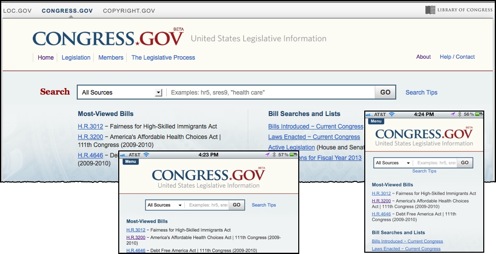
The Library of Congress launched the Congress.gov website on September 19, 2012. Congress.gov is designed to provide free public access to legislative information. Technically, the Congress.gov website is in beta release currently, and contains House and Senate bills from 2001 to the present, profiles of all members of congress from 1973 to the present and selected member profiles from 1947 to through 1972. As Congress.gov matures, it will eventually replace Thomas.gov, created in 1995 to make federal legislative information available to the public.

Congress.gov website
Congress.gov search screen displayed on various devices. Research administrators will appreciate the site technology and updated search feature.

Congress.gov is built using modern web technology that, among other advantages, fully supports accessing the site from desktop or laptop computers, tablets or smartphones with the results being displayed in device-friendly formats.

Research administrators often need information on pending or passed legislation to fully carry our duties. Presently, for example, the DATA Act is a hot topic and Congress.gov makes finding and reading that legislation easy by simply searching on that term “DATA Act” and then perusing the results or narrowing the list down until only the Senate and House bills are displayed.

The Thomas website was launched rapidly in response to the 104th Congress request to provide public access. Due to the limitations of Thomas, alternatives such as GovTrack.us have appeared to improve access to congressional information, track bills, hearings, committee meetings, and provide access to voting and other information on representatives and senators.

As pointed out by the Sunlight Foundation in its recognition of the Congress.gov website going live, there remains at least one significant gap between oft requested features and those provided by the new site: bulk access to the underlying data in a computer-readable format. This need has been noted for many years and was articulated recently in a report co-authored by staff at the Sunlight Foundation, GovTrack.us and Cornell University’s Legal Information Institute. This report was developed in response to a statement made by House leadership that endorsed bulk public access.

While blogs such as this one strive to alert research administrators to developing issues that merit their attention and provide basic information, ask questions and offer opinions, they are not always sufficient substitutes for reviewing the actual legislation, and that’s where Congress.gov will come in handy for all of us.

8.2% Reduction in US Science Budgets if Sequestraton is Implemented

No one ever expected that the across-the-board, draconian funding cuts identified as “sequestration” to be implemented. However, that’s just what will happen on January 2, 2013 unless the essentially dysfunctional US political system manages to get its collective act in gear to stop it.

Sequestration was proposed as a solution that was so drastic that it would force our leaders to come up with an effective solution to reduce the budget with less unwelcome impact while reducing the US budget deficit by $1.2 trillion. The White House released its required report to Congress on the potential impact should an alternative not be developed and sequestration be implemented. From the White House report, “no amount of planning can mitigate the effect of these cuts. Sequestration is a blunt and indiscriminate instrument.”

Some 1,200 budgets would be affected touching many important defense and non-defense programs. As summarized by Sarah Kliff on the Washington Post WonkBlog:

The sequester cuts in one graph

A quick reminder of what each of these categories encompasses:
    •    Non-exempt defense discretionary funding sees a 9.4 percent spending reduction. This covers things, such as keeping military bases open, paying salaries and research and development.
    •    Non-exempt mandatory defense spending sees the biggest cut of 10 percent.
    •    Non-exempt, non-defense discretionary funding gets cut by 8.2 percent. This includes anything that Congress has to authorize each year, so programs like Head Start and AIDS assistance.
    •    Non-exempt, non-defense mandatory programs see a 7.6 percent reduction. There’s not, however, much left to cut in this category because the large mandatory programs were largely shielded from the cuts. More on that right below.
    •    Medicare is, well, Medicare – the health insurance program for America’s seniors. The sequester specifically limited Medicare cuts to 2 percent of the program’s budget.
Keep in mind, certain programs are exempt from the sequester completely. Medicaid, the Children’s Health Insurance Program and Social Security, for example, do not get touched at all. And within the programs listed above, there are specific, smaller programs that get carved out as untouchable too.
Federal research programs at NIH, NSF, NASA, Dept. of Energy, NOAA, EPA, and others fall under the non-defense discretionary funding group and would be cut by 8.2%. David Malakoff provides a summary of the impact on science funding programs from the report at Science Insider.
There remains time for this situation to be resolved, but it will certainly not happen until after the November elections and then, a lame duck Congress will have to tackle the issue. Prepare for a bumpy ride.

NIH Announces 81 High Risk-High Reward Awards

NIH Announced  81 awards – 10 Pioneer awards, 51 New Innovator awards, and 20 Transformative Research awards – with total funding of approximately $155 million in 2012. These High Risk-High Reward program awards are given to allow talented investigators to pursue visionary science that has the potential to transform their area of science and speed the translation of research into improved health.

Congratulations to all of the 2012 recipients (the full list is available here). I want to particular note that a number of these awards were made to scientists at institutions using InfoEd Global’s research administration management software including Proposal Development and Proposal Tracking including:

Brigham and Women’s Hospital, Boston, MA
Columbia University, New York City, NY
Dana Farber Cancer Institute, Boston, MA
Massachusetts General Hospital, Boston, MA
Mount Sinai School of Medicine, New York City, NY
Northwestern University, Evanston, IL
Rockefeller University, New York City, NY
Sanford-Burnham Medical Research Institute, La Jolla, CA
University of Alabama at Birmingham, Birmingham, AL
University of California, Los Angeles, Los Angeles, CA
University of Illinois, Urbana-Champaign, IL
University of Pennsylvania, Philadelphia, PA
Yale University, New Haven, CT